Technical resource
GHK-Cu Cream and Emulsion Formulation Guide: Heat, Emulsifiers and Addition Order
GHK-Cu cream formulation can fail after a visually acceptable emulsion has already been made. Heat exposure, emulsifier selection, pH adjustment, late-stage addition and package contact can change color, viscosity, clarity at the interface or the analytical profile.
For an R&D or OEM team, the useful question is not whether GHK-Cu can be placed in a cream. The useful question is whether the selected grade can be added at a defined stage, remain evenly distributed and pass the finished formula’s stability and quality review. That decision needs a process record, not a marketing claim.
This guide gives a practical GHK-Cu cream formulation workflow for cosmetic formulators, QA teams and ingredient buyers. It covers emulsion architecture, hot and cool-down phases, emulsifiers, pH, chelators, preservatives, shear, filling and scale-up. It does not set a universal use level, pH, temperature or shelf life. Those values must come from the current supplier documents and the buyer’s own formula evidence.
GHK-Cu is commonly referenced as Copper Tripeptide-1, but a public chemical reference does not define every commercial grade. Confirm the offered form, active basis, carrier, lot and document revision before transferring a bench process to a pilot batch.
Define the cream brief before choosing the process
An emulsion process should start with the product brief. A light lotion, a rich oil-in-water cream and a water-in-oil balm can expose the copper peptide to different temperatures, interfaces and shear histories. Therefore, a route that works for one format cannot be copied into another without a controlled screen.
Set the emulsion type and sensory target
Record whether the product is an oil-in-water cream, a water-in-oil system, a gel-cream or a lamellar emulsion. Then define the target viscosity, spread, after-feel, color tolerance, odor profile and packaging. A pumpable lotion has different process limits from a jar cream with a high internal phase.
Include the intended use of the package in the brief. Airless pumps, jars, tubes and droppers expose the product to different opening patterns, headspace and contact surfaces. The active may look stable in a glass beaker and behave differently after repeated contact with a closure, elastomer or coated component.
Map the raw-material form
Confirm whether the GHK-Cu sample is a powder, a prepared solution or a carrier-based grade. Ask for the active or peptide basis used for formulation calculations, the recommended vehicle, storage wording and any grade-specific temperature or pH limitations. A powder and a diluted solution should not be added at the same percentage without a documented basis.
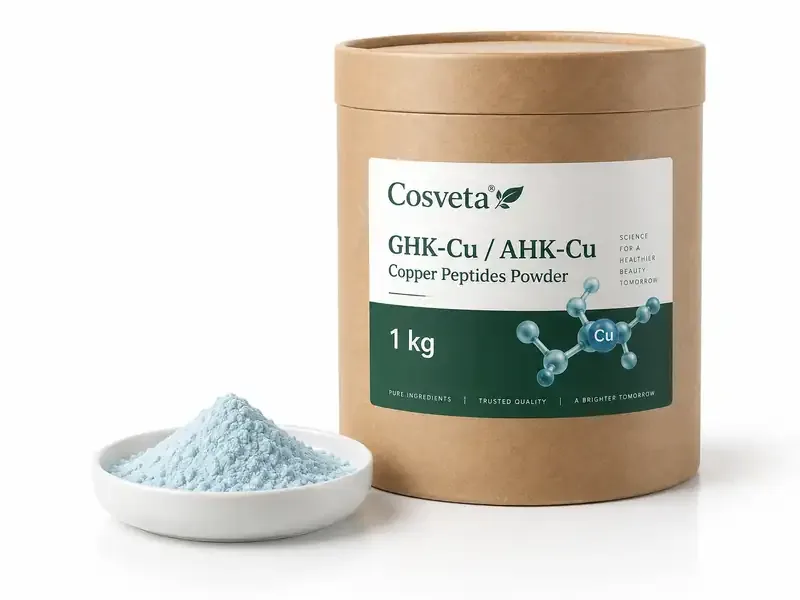
Keep the product code and lot number with the development record. Cosveta’s GHK-Cu and AHK-Cu ingredient page can support an initial product discussion, while the current TDS, specification and COA should control the final process decision.
Define acceptance endpoints
- Emulsion type, appearance and color range
- pH at a defined temperature and time point
- Viscosity method, spindle or instrument and test temperature
- Visible particles, separation, creaming, sediment or odor change
- Active distribution or analytical identity/assay method when required
- Microbiological and preservative performance requirements
- Package compatibility and filling behavior
Writing the endpoint first prevents the team from treating “looks fine on day one” as a finished approval. In practice, the cream should be judged against the specification and stability plan that apply to the final product.
Understand where GHK-Cu enters an emulsion
GHK-Cu is associated with the aqueous side of many topical cream systems, but the correct phase and addition route depend on the supplied form and complete formula. A formulator should not assume that a copper peptide belongs in the oil phase simply because the product is an emulsion.
Start with the supplier’s phase guidance
Review the current TDS for solubility, recommended vehicle, temperature and order of addition. If the document gives only a general statement such as “water soluble,” ask what concentration, water quality, pH and temperature were used. A material’s behavior in a simple aqueous test does not establish behavior inside a preserved, buffered emulsion.
Use a separate aqueous premix when it improves control
A premix can reduce local over-concentration and help the operator observe wetting before the active enters the full batch. The premix vehicle should be compatible with the finished formula and prepared under a defined temperature and mixing time. Record the concentration basis, hold time and transfer method.
Do not hold a peptide premix longer than the process or supplier information supports. If the premix sits while the emulsion cools, measure whether color, pH or visible particles change during the hold. The transfer line and vessel should also be rinsed and accounted for when the active is expensive or used at a low level.
Separate active distribution from emulsion formation
Emulsion formation and active incorporation are different operations. The high-shear step may be necessary to establish droplet size, but it may not be the best stage for a heat- or shear-sensitive active. When feasible, form the emulsion first, cool to the defined addition window, and then incorporate a controlled aqueous premix.
That approach can reduce unnecessary exposure, yet it may create a viscosity or mixing challenge. The final route should be selected by comparing distribution, appearance, pH, viscosity and stability rather than by assuming that the coolest stage is always best.
Choose the heat strategy deliberately
Many creams use heated oil and water phases to melt waxes, hydrate polymers or establish an emulsion. GHK-Cu should not be exposed to a hot phase merely because the base requires heating. First decide what the heat is doing, then decide whether the active must be present during that step.
Hot-process route
In a hot process, the oil and water phases are heated according to the base system, then combined under the required shear. This route can be efficient for waxy emulsifiers and high-viscosity creams. However, adding the copper peptide before or during that exposure can make the process harder to interpret if color or analytical changes appear later.
If a hot-process comparison is needed, use a controlled sample and record phase temperatures, hold time, mixing intensity and the exact moment of active addition. Avoid describing a single hot batch as proof of long-term stability.
Partial cool-down route
A partial cool-down route forms the emulsion at the required temperature and then reduces the batch to a defined window before adding GHK-Cu. This can limit heat exposure while preserving enough fluidity for uniform mixing. The operator must verify that the batch still has enough movement to distribute the premix without creating local pockets.
Measure temperature at the product, not only on the vessel display. Thick creams can have gradients between the wall, center and transfer line. A record should state where the temperature was measured and how the batch was mixed during the addition.
Cool-down addition
A cool-down addition is often attractive for a heat-sensitive or color-sensitive active. It is not automatically successful. High viscosity can slow dispersion, and late pH adjustment can create a local environment that differs from the rest of the cream. The team should test addition rate, mixing time and sample location before accepting the route.
Compare routes with the same endpoints
Use the same GHK-Cu basis, emulsion batch size, container, observation intervals and analytical method when comparing heat routes. Otherwise, the result may reflect a different concentration or package rather than the addition stage.
Heat and addition routes for GHK-Cu creams
| Process route | When it may fit | Main variables to control | Evidence to collect |
|---|---|---|---|
| Active in hot aqueous phase | Only when the grade and formula brief support the exposure | Product temperature, hold time, pH, agitation and light | Color, pH, viscosity, appearance and defined analytical endpoint |
| Add after emulsion formation | When the base needs heat but the active can be added during cool-down | Batch temperature, viscosity, premix concentration and addition rate | Distribution, mixing endpoint, pH drift and stability sample |
| Cool-down aqueous premix | When a controlled premix gives better wetting and lower heat exposure | Premix hold, water quality, transfer loss and shear | Premix appearance plus final cream homogeneity and package result |
| Supplier-specific process | When the grade has a defined carrier or incorporation instruction | Exact TDS revision, grade, carrier and equipment match | Documented reproduction in the buyer’s actual base |
The table is a screening framework, not a universal process specification. If the supplier’s current document conflicts with a proposed route, stop and resolve the conflict before scale-up.
Screen emulsifiers and co-emulsifiers for compatibility
Emulsifiers affect droplet formation, interfacial charge, viscosity and the way an aqueous premix moves through the batch. They may also interact with buffers, salts, polymers and preservatives. Therefore, “emulsifier compatibility” should be tested as part of the full system.
Classify the emulsifier system
Record the primary emulsifier, co-emulsifier, fatty alcohol, polymeric stabilizer and any lamellar structuring components. The same GHK-Cu grade may behave differently in a low-viscosity lotion and a structured cream because the water phase has different mobility and ionic conditions.
Do not infer performance from the emulsifier’s marketing category alone. Ask how the system was hydrated, at what phase ratio it was used and which temperature was required to form the emulsion. These process details influence the final matrix more than the ingredient name by itself.
Look for local concentration effects
A concentrated GHK-Cu premix can meet a high level of emulsifier or polymer at the point of addition. That local contact may create transient haze, clumping or viscosity change even when the diluted final formula is compatible. Add the premix under enough movement to disperse it quickly, but avoid adding shear that introduces excess air.
Include a blank and a reference cream
A blank cream without GHK-Cu shows whether the base itself changes under the process. A reference cream with a known compatible addition route helps the team distinguish an equipment problem from an active-related effect. Keep both samples in the same package and stability schedule when the comparison matters.
Review the interface, not just the bulk
Inspect the cream after filling and during storage. A copper peptide may appear evenly distributed in the vessel while showing a color ring near the pump, cap or air interface. Record the location and timing of any change. Interface observations can point to oxygen, metal contact, headspace or incomplete mixing.
Control pH, buffers and chelators
pH is a process variable, a preservation variable and a compatibility variable. It should be measured at a defined temperature and after the batch has equilibrated. A reading taken immediately after acid or base addition can mislead the development team.
Set the pH window from the full formula
Start with the intended preservative system, polymer, emulsifier, other actives and sensory brief. Then compare that window with the supplier’s information for the GHK-Cu grade. If the windows do not overlap, evaluate another grade, a different process or a revised product brief rather than forcing a number that the system cannot hold.
Define the adjustment sequence. For example, the team may incorporate the active, allow the batch to mix, measure pH, and make a controlled adjustment. Another formula may require a different sequence. Document the actual operation and avoid presenting one sequence as a rule for all creams.
Screen buffer salts and electrolytes
Buffers and electrolytes can change ionic strength, viscosity and the appearance of the emulsion. Introduce them in a controlled matrix and observe whether the effect occurs immediately or after a hold. A visible change after buffer addition may be an interaction within the cream, not evidence that the peptide is inherently unstable.
Treat chelators as an experimental factor
EDTA and other chelating systems deserve a deliberate compatibility check when a copper-containing active is present. A chelator may be required for a broader formula strategy, yet its impact on the active system should be evaluated rather than assumed. Compare a matched batch with and without the chelator when the project allows it.
Record pH, color, viscosity, visible particles and the defined identity or assay endpoint. If the result is ambiguous, involve the supplier and quality team. Appearance alone cannot establish the chemical state of the copper peptide.
Use a controlled addition order
Addition order controls local concentration, hydration, air entrainment and the time each ingredient spends under shear or heat. A simple process map helps a second operator reproduce the batch.
Build the base first
Prepare the water and oil phases according to the selected emulsion system. Hydrate polymers, dissolve salts and melt structuring ingredients under the defined conditions. Keep the phase records separate so that a later investigation can identify whether the change started before or after GHK-Cu addition.
Form the emulsion under the required shear
Combine the phases using the equipment and mixing profile that the process can reproduce. Record impeller type, approximate speed, time and vessel scale. A bench rotor-stator result may not represent a production sweep, so note the limits of the comparison.
Prepare and transfer the GHK-Cu premix
Use the material basis and vehicle defined in the screening plan. Confirm that the premix has no visible particles before transfer, but do not interpret clarity as proof of identity or potency. Rinse the premix vessel only when the rinse is compatible with the formula and the transfer recovery is documented.
Add at the defined temperature and rate
Add the premix slowly enough to avoid a local pocket and quickly enough to prevent an extended hold. Maintain controlled movement throughout the transfer. Measure the product temperature at the addition point and record the time from start to completion.
Finish pH, preservation and filling steps
Complete the defined pH adjustment, preservative or fragrance addition, deaeration and filling operations. Keep the sample used for immediate evaluation and the retains used for stability linked to the same batch, lot and document revisions.
GHK-Cu cream process control matrix
| Variable | Question for the formulator | Suggested observation | Decision record |
|---|---|---|---|
| Material form | Is the sample a powder, solution or carrier-based grade? | Identity, basis, appearance and premix behavior | Approve the exact form or request clarification |
| Addition temperature | Can the active be incorporated without unnecessary heat? | Temperature profile, color and analytical endpoint | Select a supported hot, partial cool-down or cool-down route |
| Premix vehicle | Does the vehicle disperse the grade without changing the base? | Wetting, particles, hold time and transfer recovery | Define vehicle, concentration basis and maximum hold |
| Emulsifier system | Does the premix remain compatible with the interface and structure? | Viscosity, separation, haze and package contact | Keep, adjust or screen another system |
| pH and buffer | Does the finished formula hold the required pH window? | Initial and equilibrated pH, color and viscosity | Confirm the adjustment sequence and limits |
| Chelator | Does the chelator change appearance or analytical behavior? | Matched comparison with and without chelator | Retain only with documented compatibility evidence |
| Package | Does the container alter color, odor or dispersion? | Headspace, closure contact and repeat-opening checks | Approve the pack or open a compatibility investigation |
Use the matrix to separate a process decision from a supplier decision. If the same grade works in a simple cream but fails after one formula component is introduced, investigate that component before rejecting the raw material.
Troubleshoot separation, haze and color change
An observation is a starting point, not a diagnosis. The first response should describe the event, link it to the process time and compare it with a blank or reference batch.
Cloudiness or haze
Check incomplete wetting, local premix concentration, salt load, buffer interaction, polymer hydration and package contact. Repeat the trial with the same active basis and one controlled change. If haze occurs only after filling, inspect the pump, closure and headspace rather than changing the emulsifier immediately.
Separation or creaming
Review phase temperatures, emulsification energy, phase ratio, cooling rate and viscosity development. Confirm that the active addition did not dilute or shock the interfacial structure. A late aqueous addition can change the water-phase volume or local temperature, so compare the process with and without that addition.
Color shift
Record when the color shifted and where it appeared. Heat, light, oxygen, redox ingredients, trace metal contact, package materials and a changed raw-material lot can all be relevant variables. Compare a protected control and a package retain before assigning the cause to GHK-Cu.
pH drift or viscosity loss
Measure both pH and viscosity with a defined method and temperature. Check buffer capacity, polymer hydration, preservative interaction, mixing time and sampling location. Do not compare a warm sample with a room-temperature sample as if they were equivalent.
Use analytical evidence when the decision matters
For a failed high-value trial, visual inspection should be supported by an appropriate analytical plan. Depending on the specification, the team may review identity or related-substance information, peptide or active content, copper content, microbiology, pH, viscosity and package compatibility. The method must answer the question being asked.
For chemical identity context, the PubChem Copper Tripeptide-1 record is a useful reference. It does not prove the identity, purity, stability or performance of a supplier lot.
Plan stability and package compatibility together
Stability should challenge the formula in the package and conditions that matter for the commercial brief. A clear cream on the day of manufacture is an early development result, not a shelf-life conclusion.
Define the purpose of each condition
Real-time storage shows the intended product condition over time. Accelerated conditions may expose a risk earlier, but they do not automatically establish a final shelf life. Light or temperature cycling may be relevant when the product or distribution path permits those exposures.
For each condition, record the batch, container, fill level, duration, sample frequency and endpoints. Include appearance, odor, pH, viscosity, separation, microbiology and the analytical endpoint defined for the active when appropriate.
Compare final and control packages
Run a protected control when light or headspace could affect the result. Observe elastomers, metal springs, coatings and closure contact. In addition, record whether the first and last fills from the vessel show the same appearance, because poor dispersion can be hidden by sampling only from the center.
Retain samples and document revisions
Keep retain samples linked to the raw-material lot, process batch, package lot and current specification. If a supplier changes the TDS or COA format, review whether the identity, storage, form or process information changed. Cosveta’s quality and documentation page and COA, TDS and SDS guide provide useful document-review context.
For good manufacturing practice context, consult the ISO 22716 cosmetics GMP standard page. The standard reference does not replace the buyer’s own process validation, specification or regulatory review.
Scale the process from bench to pilot
Scale-up changes mixing geometry, heat transfer, cooling time, addition distance and air removal. Therefore, a successful bench batch should be treated as a process hypothesis until the pilot equipment reproduces the relevant endpoints.
Match the critical process variables
Record the variables that matter for the product: phase temperatures, product temperature at active addition, impeller or rotor-stator profile, mixing time, addition rate, vessel fill level and cooling slope. Do not copy a bench rpm to a larger vessel without considering the equipment and energy input.
Protect the transfer and filling step
Check whether the cream sits in a transfer hose, recirculation loop or holding tank after GHK-Cu addition. Measure the time and temperature for that hold. A product can pass in the vessel and show a different result after a warm transfer or repeated recirculation.
Review sampling locations
Sample from the top, center and bottom when the development risk justifies it. Compare appearance, pH and viscosity, and use the defined analytical method when required. Uneven results point to mixing or addition control, not automatically to a failed raw material.
Lock the approved process window
Once the route passes the planned checks, record the accepted addition stage, temperature window, mixing time, pH sequence, hold time, package and document revision. Changes should trigger a documented assessment rather than an informal substitution.
Build the supplier document set into the formulation file
A TDS, COA and SDS answer different questions. The R&D file should retain the documents used to select the grade and link them to the formulation trial.
Specification and TDS
Confirm product code, identity reference, form, active basis, appearance, solubility language, storage, package and any process guidance. Read “recommended for cream” as a starting point that still requires verification in the buyer’s formula.
COA and lot evidence
Check whether the COA is lot-specific or representative. Review lot number, actual results, specification limits, methods, units and reporting basis. Keep HPLC purity, peptide content, copper content and identity as separate review fields rather than treating one result as proof of all four.
SDS and handling
Route the SDS to the team responsible for handling and emergency review. It supports hazard communication and storage decisions; it does not establish the cream’s stability, efficacy or finished-product safety.
Supplier qualification
Use Cosveta’s cosmetic ingredient supplier qualification checklist to connect technical documents, sampling, QA review and commercial approval. Ask the supplier to identify the exact grade and process assumptions behind any formulation recommendation.
For general cosmetic regulatory context, review the U.S. FDA cosmetics products and ingredients overview. It is a public reference for regulatory responsibilities and does not certify a particular ingredient, formula or claim.
Frequently asked questions
Can GHK-Cu be added to the hot phase of a cream?
Only when the grade and the buyer’s evidence support that route. First compare a controlled hot-phase sample with an after-emulsion or cool-down route, record the time-temperature profile and review appearance, pH, viscosity and the defined analytical endpoint.
Should GHK-Cu be added to the water phase or the cool-down phase?
The answer depends on the supplied form and the complete formula. A controlled aqueous premix added after emulsion formation may reduce heat exposure, but high viscosity or late pH adjustment can create new risks. Test the route that the process can reproduce.
Which emulsifier is best for GHK-Cu cream formulation?
There is no universal best emulsifier. Select a system that meets the required emulsion type, sensory target, pH and processing conditions, then test it with the exact GHK-Cu grade, buffer, chelator, preservative and package.
Can I use EDTA with a GHK-Cu cream?
Treat EDTA and other chelators as compatibility variables. Run a matched comparison when appropriate and review pH, color, viscosity, visible particles and suitable analytical evidence. Do not approve or reject the combination from a general rule alone.
Why did the cream become cloudy after GHK-Cu was added?
Possible causes include incomplete wetting, local concentration, salt or buffer interaction, polymer hydration, temperature shock or package contact. Repeat the trial with a blank and one changed variable at a time before changing the grade.
Does a clear premix guarantee a clear GHK-Cu cream?
No. The emulsion interface, polymers, preservatives, electrolytes, pH and package can change the result after the premix enters the full formula. Confirm the finished cream at the intended concentration and process stage.
How should I compare a powder and solution grade?
Normalize the comparison to the supplier’s defined active or peptide basis, then record carrier, water, excipients and addition volume. A direct percentage comparison can be misleading when the grades have different forms or concentrations.
What should I record during the first pilot batch?
Record raw-material lot, product form, document revision, phase temperatures, emulsion shear, active premix details, addition temperature and rate, pH sequence, cooling profile, hold time, filling conditions and sampling results. Those records make a failed batch diagnosable.
Summary: make GHK-Cu cream formulation reproducible
A reliable GHK-Cu cream process begins with the exact grade and a clear product brief. Define the emulsion type, pH window, temperature exposure, active basis, emulsifier system, package and acceptance endpoints before the bench trial.
Then compare a supported hot, partial cool-down or cool-down route with the same analytical and visual checks. Add the active through a controlled aqueous premix when that improves distribution, but verify viscosity, transfer time and hold behavior. Treat emulsifiers, buffers, chelators, preservatives and packaging as process variables rather than assumptions.
For Cosveta’s ingredient and application resources, review the GHK-Cu / AHK-Cu product page, cosmetic applications page, ingredient catalog and request a formulation review and sample. Include your target emulsion type, pH, process temperature, package and document requirements in the enquiry.
Bench checklist: Before the first cream trial, record product code, lot, form, active basis, emulsion type, emulsifier system, phase temperatures, addition route, pH sequence, premix hold, shear profile, package, endpoints and document revision.